

MIT Robotics Seminar | Amanda Prorok (University of Cambridge)
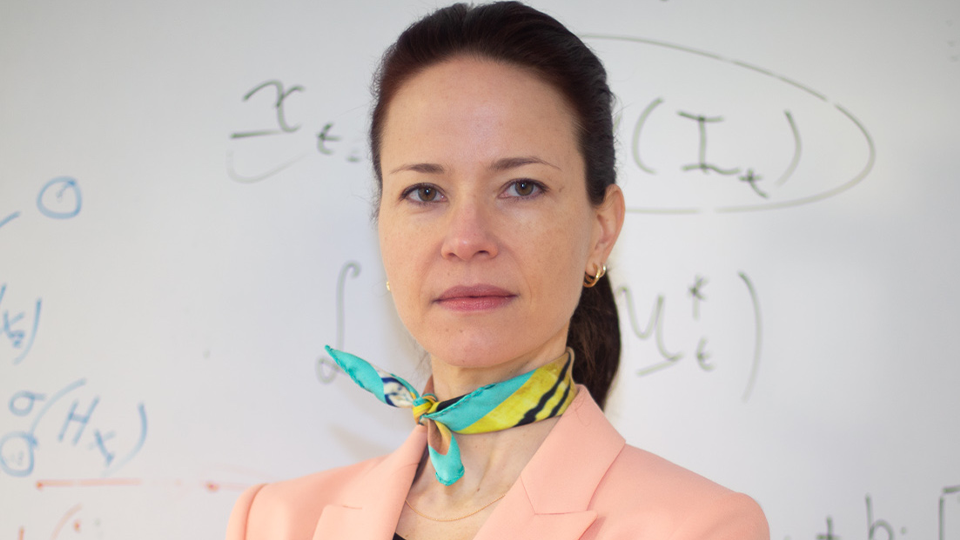
Abstract: As autonomous robots and multi-agent swarms transition into complex, public environments, establishing trust and accountability has become a critical bottleneck. This requires making physical AI readable in two ways: how an embodied agent authenticates its identity to the outside world, and how it models the hidden behaviors of peers. In this talk, I will explore this dual challenge. I begin by addressing the “Physical Observation Gap” in remote robot authentication. By subtly shaping the inherent exploration noise of stochastic policies, we demonstrate how physical motion itself can be transformed into a communication channel. I will introduce our recent frameworks for motion watermarking and messaging, which allow robots to transmit provenance and team strategies to authorized observers using only ordinary video, bypassing traditional wireless links. Shifting from outward authentication to modeling hidden intent, we will then explore how agents learn to predict the actions of others. Because the optimal representation of opponent intent is fundamentally task-dependent, I introduce an adaptive framework that dynamically weights multiple behavioral representations to achieve robust decision-making across diverse environments. Together, these lines of research provide the building blocks for an accountable ecosystem of physical AI, characterized by both legible actors and adaptive perceivers.
Amanda Prorok is Professor of Collective Intelligence and Robotics in the Department of Computer Science and Technology at the University of Cambridge, and a Fellow of Pembroke College. In her work, she pioneered differentiable communications methods for multi-agent systems, with applications to multi-robot perception and control. Amanda has given invited keynotes at TEDx and IEEE ICRA, and has been honored by numerous research awards, including a prestigious ERC Starting Grant. Amanda is an IEEE Senior Member, serves as Associate Editor for Autonomous Robots (AURO) and was the Chair of the 2021 IEEE International Symposium on Multi-Robot and Multi-Agent Systems. Her PhD thesis was awarded the Asea Brown Boveri (ABB) prize for the best thesis at EPFL in Computer Science.


Stay up-to-date with the LIDS Latest newsletter


Massachusetts Institute of Technology
Room 32-D608
77 Massachusetts Avenue
Cambridge, MA 02139

